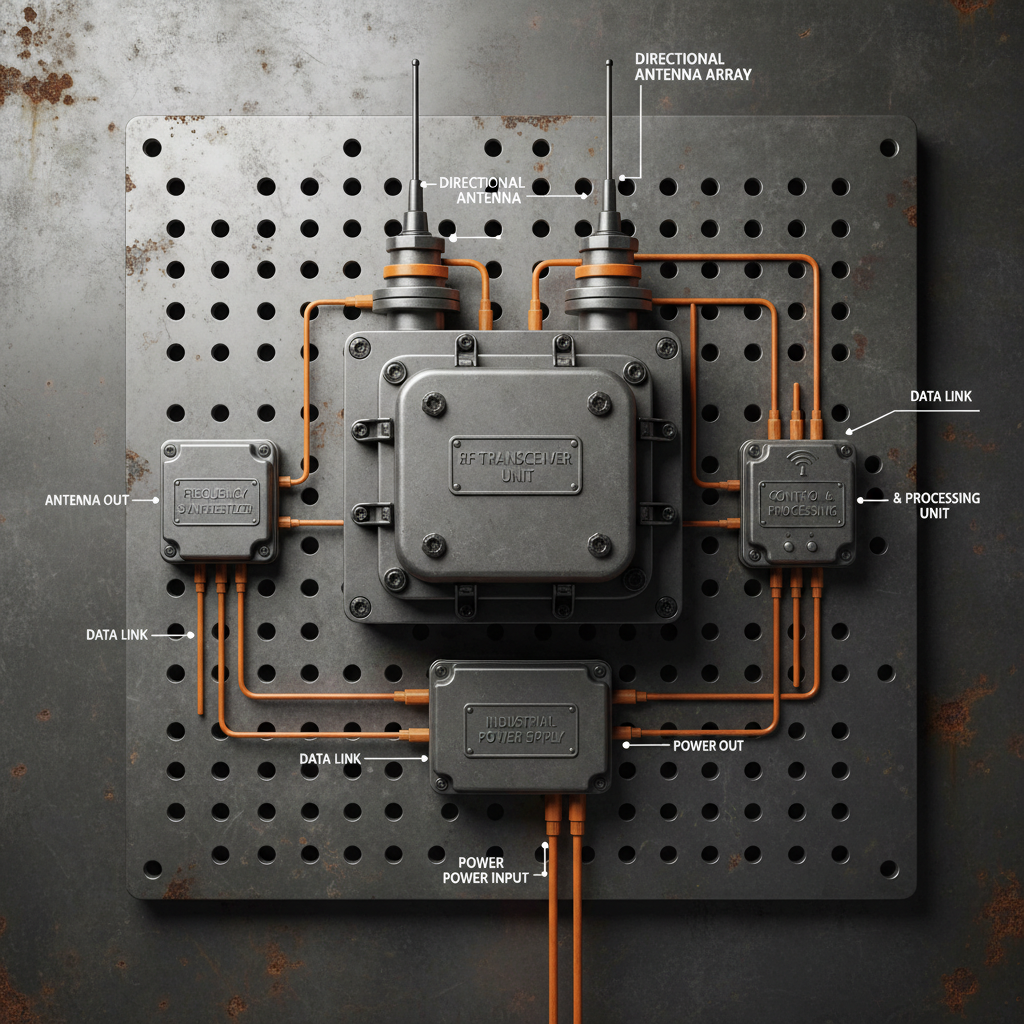

Achieving high linearity and efficiency in radio frequency (RF) signal amplification remains one of the most significant hurdles in wireless system engineering. As bandwidth requirements expand and signals become more complex, the traditional approach to power amplification is no longer sufficient to meet the stringent demands of modern communication and defense electronics.
The shift toward wideband operation and high-frequency spectrums has forced a transition from simple saturation-based designs to sophisticated architectures that balance power density with thermal stability. Engineers are now integrating GaN technology, digital pre-distortion (DPD), and advanced matching networks to overcome the inherent trade-offs between gain, efficiency, and spectral purity.
Understanding the advanced techniques in rf power amplifier design is essential for anyone deploying high-performance RF solutions, from spectrum detectors to complex jamming systems, where signal integrity directly impacts operational success.


The transition from traditional vacuum tube amplifiers to solid-state RF power amplifiers (SSPAs) marked the first major shift in the industry. Early SSPAs relied heavily on LDMOS technology, which provided reliability but struggled with efficiency at higher frequencies.
Modern designs have pivoted toward Gallium Nitride (GaN) on Silicon Carbide (SiC) substrates, enabling significantly higher power densities and the ability to operate at higher voltages. This evolution allows for the creation of compact, wideband amplifiers that can cover frequencies from 100MHz to 6000MHz without sacrificing gain stability.
When implementing advanced techniques in rf power amplifier design, engineers must focus on the interaction between gain flatness and harmonic suppression. Gain flatness ensures that the amplifier provides a consistent boost across the entire operating bandwidth, which is critical for wideband applications such as drone detectors or multi-band jammers.
Harmonics and spurious levels are equally vital. In high-power systems, unwanted emissions can interfere with adjacent channels or trigger false positives in spectrum detectors. Achieving a spurious level of 60dBc or better requires precise filtering and careful layout to prevent parasitic oscillations within the chassis.
The input and output Voltage Standing Wave Ratio (VSWR) serves as the primary metric for impedance matching. A low VSWR (typically 2:1 or better at the output) minimizes signal reflection, preventing potential damage to the power transistor and ensuring maximum power transfer to the antenna system.
Heat dissipation is the primary bottleneck in RF amplifier miniaturization. As peak output power increases—such as in systems reaching 100W—the amount of thermal energy generated can quickly degrade the semiconductor junction, leading to thermal runaway or permanent component failure.
Effective RF design requires a holistic approach where the thermal resistance of the housing is matched to the power dissipation of the amplifier module, ensuring the device remains stable at operating temperatures of 50°C and above.
Modern chassis designs utilize hybrid cooling methods, combining high-thermal-conductivity copper heat sinks with aluminum housings. Furthermore, implementing wide-voltage input ranges (e.g., 24-32VDC) allows for better power regulation and reduces the heat generated by inefficient DC-DC conversion stages.
Drain efficiency is a critical metric for portable and vehicle-mounted RF systems. In wideband designs covering 100-6000MHz, maintaining an efficiency of 50% to 55% is considered a high benchmark. This efficiency directly dictates the current consumption—for instance, a 100W output system typically requiring around 7.0A of current.
The trade-off usually exists between efficiency and linearity. While Class C amplifiers offer high efficiency, they introduce significant distortion. Advanced techniques in rf power amplifier design often employ "Doherty" architectures or digital correction to maintain high efficiency while ensuring a clean signal for complex modulation.
RF power amplifiers do not operate in isolation; they are core components of larger security ecosystems. In a typical electronic countermeasure (ECM) setup, the amplifier must be seamlessly integrated with a Tx/Rx spoofing module and a GPS spoofer. The ability to handle a wide frequency range (300-6000MHz) allows a single amplifier to support multiple jamming bands, reducing the total weight and footprint of vehicle-mounted jammers.
For detection systems, such as AOA passive spectrum detectors, the reverse is true: low-noise amplification is prioritized. However, for active defense, the power amplifier's role is to overwhelm the target signal. The integration of Automatic Level Control (ALC) via a Hybrid D-Sub interface allows the system to dynamically adjust output power based on the detected threat level, optimizing energy use and reducing the probability of detection.
The industry is currently moving toward the integration of AI-driven adaptive matching. By using real-time sensors to monitor VSWR and temperature, amplifiers can adjust their internal bias points to maintain peak efficiency regardless of the antenna environment. This reduces the reliance on bulky external matching networks.
Another trend is the move toward "Software-Defined Power." By utilizing high-speed FPGA control over the amplifier's enable and ALC pins, systems can switch between narrowband and broadband modes in microseconds. This flexibility is essential for countering frequency-hopping drone communication protocols.
Furthermore, the development of GaN-on-Diamond substrates promises to solve the thermal bottleneck once and for all. Diamond's superior thermal conductivity allows for even higher power densities, potentially doubling the output power of a 50W system without increasing the module's physical dimensions.
Choosing the right RF power amplifier requires a strict evaluation of the application's spectral requirements. A user seeking to implement a handheld drone detector will prioritize size and energy efficiency, whereas a manufacturer of fixed chassis jamming systems will prioritize raw output power and long-term thermal stability.
One must also consider the interface specifications. For professional-grade equipment, a standard Hybrid D-Sub 6-Pin connector is preferred for its durability and ability to carry both high-current DC power and sensitive analog telemetry, such as temperature and current monitoring signals.
Ultimately, the balance between Power Gain (e.g., 50±3 dB) and Gain Flatness (±1 dB) determines the quality of the transmitted signal. Over-amplification can lead to saturation and clipping, while under-amplification fails to overcome the path loss of the wireless channel.
| Evaluation Factor | Critical Requirement | Impact of Failure | Selection Priority |
|---|---|---|---|
| Frequency Bandwidth | 100 - 6000 MHz | Limited signal coverage | High |
| Output Power (PSAT) | 50W to 100W | Insufficient range | High |
| Gain Flatness | ±1 dB | Signal distortion | Medium |
| Efficiency (EFF) | >50% | Excessive heat/battery drain | Medium |
| Spurious Level | <-60 dBc | Electromagnetic interference | High |
| Operating Voltage | 24V - 32V DC | Power instability | Low |
Gain flatness ensures that the amplifier provides a consistent amount of amplification across its entire operating frequency range. Without it, some frequencies would be boosted more than others, causing signal distortion and inconsistent performance in wideband applications like drone detection or spectrum monitoring.
Gallium Nitride (GaN) offers higher electron mobility and a larger bandgap than silicon. This allows GaN amplifiers to operate at higher voltages, handle more power in a smaller area, and maintain higher efficiency at microwave frequencies, significantly reducing the size of the final hardware.
A high Voltage Standing Wave Ratio (VSWR) indicates a mismatch between the amplifier output and the load (antenna). This causes RF energy to reflect back into the amplifier, which can cause overheating, degrade signal quality, and in extreme cases, destroy the power transistor.
ALC allows the system to maintain a constant output power level regardless of fluctuations in the input signal or power supply. This prevents the amplifier from entering deep saturation, which would create harmonics and reduce the effectiveness of the jamming signal.
Yes, wideband amplifiers are specifically designed for this. However, achieving high gain and efficiency across such a broad spectrum requires advanced matching networks and often a multi-stage design to ensure the signal remains stable at both the lower and upper frequency limits.
Depending on the efficiency, a 100W system typically draws between 6A and 8A at 28VDC. For example, a system with 52% efficiency will consume more current than one with 55% efficiency to achieve the same peak output power.
The implementation of advanced techniques in rf power amplifier design is a continuous balancing act between power, efficiency, and thermal constraints. As the RF environment becomes more crowded and threats more sophisticated, the ability to deploy wideband, high-linearity amplification will remain a cornerstone of electronic warfare and communication security.
By focusing on semiconductor innovation and rigorous thermal engineering, companies like Shenzhen Yiyuan are enabling the next generation of RF solutions—ensuring that whether it is a handheld detector or a vehicle-mounted system, the signal remains powerful, precise, and reliable.