

High Efficiency 50W Wideband RF Module Supplier Solution
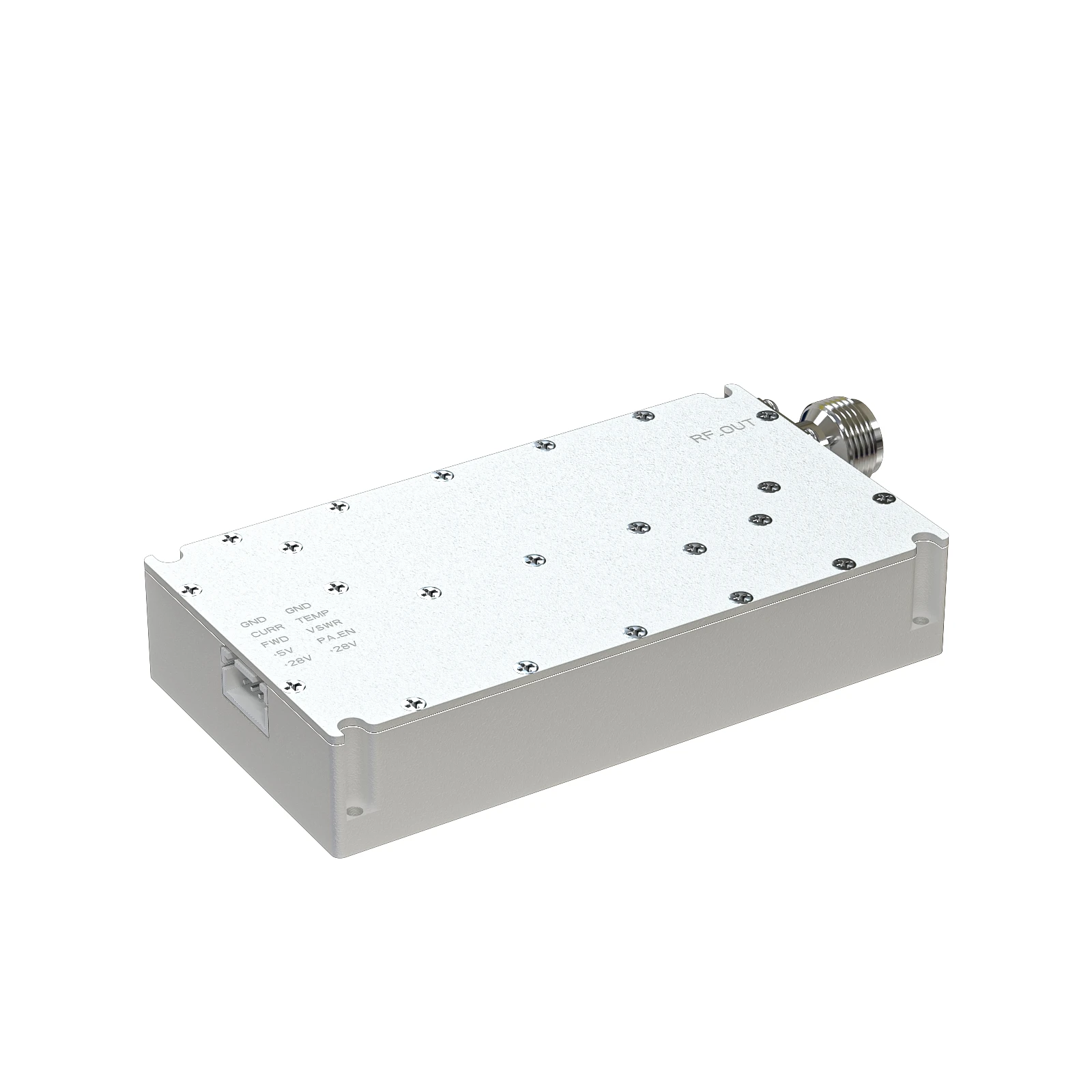
Integrating high-efficiency signal amplification into wideband communication systems requires a precise balance of power output and spectral purity. For engineers designing secure communication channels or defense-grade surveillance systems, the stability of the RF front-end is paramount. This particular 50W RF power amplifier module is engineered to operate across a broad frequency range from 100 to 6000MHz, providing a robust solution for those seeking a reliable rf module supplier capable of delivering consistent gain and high efficiency in complex electromagnetic environments.
By utilizing a wide voltage input range (24-32V) and incorporating critical monitoring interfaces for temperature and VSWR, this module ensures operational longevity even under rigorous duty cycles. Whether the application involves telecommunications infrastructure or specialized security hardware, the integration of a high-linearity power amplifier is essential for maintaining signal integrity and maximizing coverage without compromising the underlying hardware stability.

Technical Architecture of Wideband RF Power Amplification
The core of this module is designed around a wideband architecture that maintains a stable power gain of approximately 47dB. Unlike narrowband amplifiers that struggle with signal dispersion at the edges of their range, this system is optimized for a frequency span of 100-6000MHz. This versatility allows a single hardware implementation to support multiple communication protocols, reducing the need for multiple discrete components in a system rack.
Efficiency is a critical metric for high-power RF components to prevent thermal runaway. With a typical efficiency rating of 52%, the module minimizes waste heat, which is further managed by the integrated temperature monitoring pin. This allows system controllers to implement active cooling or power throttling in real-time, ensuring that the 50W peak output remains stable across various operating temperatures (TC=50°C).
- Broadband Versatility: Covers everything from VHF to UHF and into the microwave spectrum.
- Power Stability: Delivers a consistent 50W output with a maximum VSWR of 2:1.
- Thermal Management: Analog temperature voltage output for precise heat tracking.

Critical Interface Logic and System Monitoring
Reliability in the field is often determined by the ability of the module to communicate its health to the main processor. This unit employs a Hybrid D-Sub 10-Pin connector that provides more than just power and signal paths; it offers a comprehensive telemetry suite. The inclusion of a dedicated VSWR alarm pin allows the system to detect antenna mismatches instantly, preventing permanent damage to the power transistors.
Furthermore, the module features a flexible power enable (PA_EN) function using TTL logic. This enables rapid power-cycling and energy-saving modes, which are essential for battery-operated defense equipment or remote telecommunication towers. The current consumption is meticulously monitored via an analog voltage output (100mV per Ampere), giving operators an exact view of the power draw relative to the 50W output state.
From an engineering perspective, the separation of the 28VDC main supply and the 5V external power supply ensures that the control circuitry remains isolated from power fluctuations on the high-current line, thereby enhancing the overall signal-to-noise ratio and reducing spurious emissions.
Application Scenarios in Defense and Communication
In the realm of electronic warfare and signal security, the ability to generate a powerful, stable signal across a wide spectrum is indispensable. This module is frequently deployed in RF jamming systems where blocking unauthorized signals requires high peak power and high efficiency. Because the unit can cover 100-6000MHz, it can effectively neutralize a wide array of communication frequencies without requiring multiple amplifier stages.
Beyond security, the module serves as a critical component in advanced signal analysis and surveillance systems. When paired with high-sensitivity RF detectors, the amplifier ensures that transmitted signals reach their intended targets over long distances, overcoming atmospheric attenuation and physical obstructions. Its high gain flatness (±1dB) ensures that the spectral characteristic of the original signal is preserved, which is vital for complex modulation schemes.
For OEM integrators, the wide voltage input (24-32V) simplifies the power distribution network, allowing the module to be integrated into existing 28V DC aircraft or vehicle power systems without requiring additional voltage regulators, thus reducing the overall weight and footprint of the final assembly.
Detailed RF Performance and Electrical Metrics
| Parameter | Minimum Value | Typical Value | Maximum Value |
|---|---|---|---|
| Operating Frequency Range | 100 MHz | - | 6000 MHz |
| Peak Output Power (CW) | - | 50 W | - |
| Power Gain (at 0dBm input) | - | 47 ± 3 dB | - |
| Efficiency (Typical) | 50% | 52% | 55% |
| Output VSWR | - | - | 2:1 |
Selecting the Right RF Amplification Solution
When evaluating a potential rf module supplier, procurement managers must look beyond the raw power numbers. The real value lies in the "hidden" specifications: gain flatness, spurious levels, and the robustness of the protection circuitry. A module that offers 50W but lacks VSWR protection is a liability in field operations where antenna cables may be damaged or improperly terminated.
The choice between an off-the-shelf module and an ODM customized solution depends on the specific environmental constraints of the project. For standard telecommunications, a wideband module like this one provides the necessary flexibility. However, for aerospace applications, considerations regarding weight, vibration resistance, and extreme temperature ranges become the primary drivers for selection.
Quality assurance should focus on the consistency of the harmonics. With this module providing harmonics from 12 to 15dBc, it ensures that the output signal does not interfere with adjacent channels, meeting the strict international standards required for licensed frequency bands in defense and law enforcement applications.
Future Trends in Wideband RF Technology
The trajectory of RF technology is moving toward increased bandwidth and higher energy efficiency. As we see the rise of software-defined radio (SDR), the demand for amplifiers that can handle an extremely wide range of frequencies—without the need for mechanical switching—is increasing. The transition from traditional LDMOS to Gallium Nitride (GaN) is enabling higher power densities and better thermal performance.
Integration is another key trend. We are seeing a shift toward "intelligent" RF modules that incorporate onboard digital diagnostics (via I2C or SPI) rather than simple analog telemetry. This allows for remote health monitoring and predictive maintenance, reducing the downtime of critical communication infrastructure in remote locations.
As signal environments become more crowded, the focus is shifting toward improving spurious-free dynamic range (SFDR). The ability to amplify a signal while keeping the noise floor extremely low will be the primary competitive advantage for next-generation RF solutions in the security and defense sectors.
Frequently Asked Questions About RF Power Modules
What is the significance of the 2:1 Output VSWR specification?
VSWR (Voltage Standing Wave Ratio) measures how efficiently RF power is transmitted from the amplifier to the antenna. A 2:1 ratio indicates that a manageable amount of power is reflected back to the source. High VSWR can cause overheating or permanent damage to the amplifier, which is why this module includes a dedicated VSWR alarm pin for system protection.
Can this module be used for continuous wave (CW) transmissions?
Yes, the module is specified for a Peak Output Power of 50W @ CW Signal. However, for long-term CW operation, it is critical to ensure adequate heat sinking and to monitor the temperature via the analog TEMP pin to prevent thermal degradation.
How does the wide voltage input (24-32V) benefit the system?
The wide input range allows the module to be powered directly from standard industrial or military 28V DC power rails without the need for additional voltage regulators. This reduces the component count, lowers the risk of failure points, and improves overall system efficiency.
What is the difference between the +28V and +5V pins on the connector?
The +28V pins are the primary power source for the RF power amplification stage, which handles the heavy current load. The +5V pin is used to power the internal control logic and monitoring circuitry, ensuring that the control signals remain clean and unaffected by power ripples on the high-voltage line.
Is it possible to customize the frequency range or power output?
Yes, Shenzhen Yiyuan provides flexible OEM and ODM services. Depending on your specific requirements, the frequency range, gain, and output power can be tailored to align with your unique design criteria or specialized operational needs.
How should I handle the PA_EN pin for power management?
The PA_EN pin uses TTL logic. Applying a high signal (3.3V) enables the amplifier, while a 0V signal turns it off. This allows the system controller to precisely manage power consumption and reduce electromagnetic interference when transmission is not required.
Technical References and Industry Standards
- IEEE Xplore Digital Library for RF Engineering Standards
- NIST Guidelines on Electromagnetic Interference and Compatibility
- International Telecommunication Union (ITU) Frequency Allocations
- ARRL Technical Resource for RF Power Amplification
Choosing a high-performance RF solution requires a deep understanding of the trade-offs between bandwidth, efficiency, and thermal stability. By leveraging the advanced wideband capabilities of the 100-6000MHz 50W module, engineers can build more resilient and flexible communication systems. For detailed integration support or custom ODM requirements, we invite you to connect with our technical team.
Related Technical Insights



 English
 Arabic
 Belarusian
 Danish
 Dutch
 French
 German
 Greek
 Japanese
 Korean
 Myanmar
 Polish
 Portuguese
 Russian
 Spanish
 Swedish
 Thai
 Ukrainian
 Vietnamese